

Industry insight: this article describes how the technology is used in the industry. It is not a Metaverse911 client project. See our case studies for our own work.
The situation: forklift training is risky and ties up machines
Operating a powered industrial truck (PIT), usually called a forklift, is one of the most hazardous jobs in a warehouse or factory. Forklift accidents remain a leading cause of workplace injuries and deaths worldwide, despite strict safety rules.
For a premier, OSHA-certified PIT training institution, the problem was not the curriculum. It was the limits of physical training. Practical sessions take an expensive machine out of production, need a large safe area, and expose novices to real risk before they have the spatial awareness and control to handle it.
Classroom theory cannot recreate a busy warehouse. Reading about a forklift's turning radius is very different from steering a three-ton machine round a blind corner with an unbalanced load. The institution wanted a step between the classroom and the real forklift, where trainees could practise, face hazards and make mistakes safely.
What they did: a realistic simulator, not a game
The institution knew that simple, game-like VR would not meet its OSHA-aligned standards. A simulation that felt like an arcade game could build false confidence. It needed realistic physics for weight distribution, momentum and the rear-wheel steering that makes forklifts hard to master.
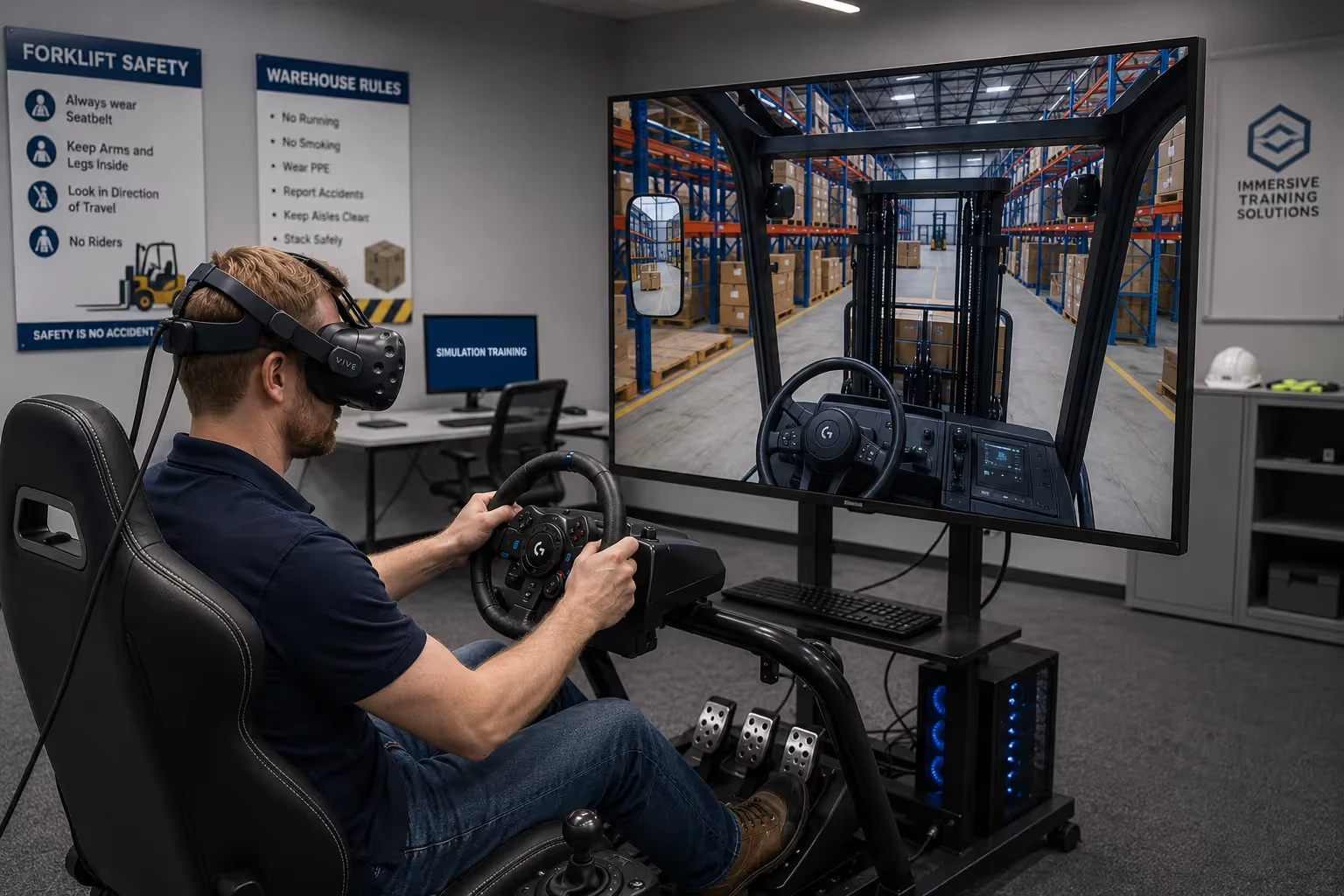
Working with a specialised VR development agency, it commissioned a bespoke forklift simulator. It chose a PC-tethered VR setup over standalone headsets, giving up portability for the processing power needed to render a detailed, physics-accurate warehouse. Trainees had to be able to read small warning labels on virtual pallets and judge distances down long, dimly lit aisles. A physical steering wheel and pedals made the controls feel like the real machine.
How it works
The hardware
- A high-performance PC runs the simulation at a consistently high frame rate. Any lag between head movement and the image can cause motion sickness.
- An HTC Vive Pro 2 headset gives high resolution and a wide field of view, which matters because operators must constantly scan for pedestrians and obstacles.
- A Logitech G920 steering wheel and pedal set builds real muscle memory for steering, accelerating and braking. The wheel resistance and pedal travel mimic an industrial vehicle.
The instructor panel
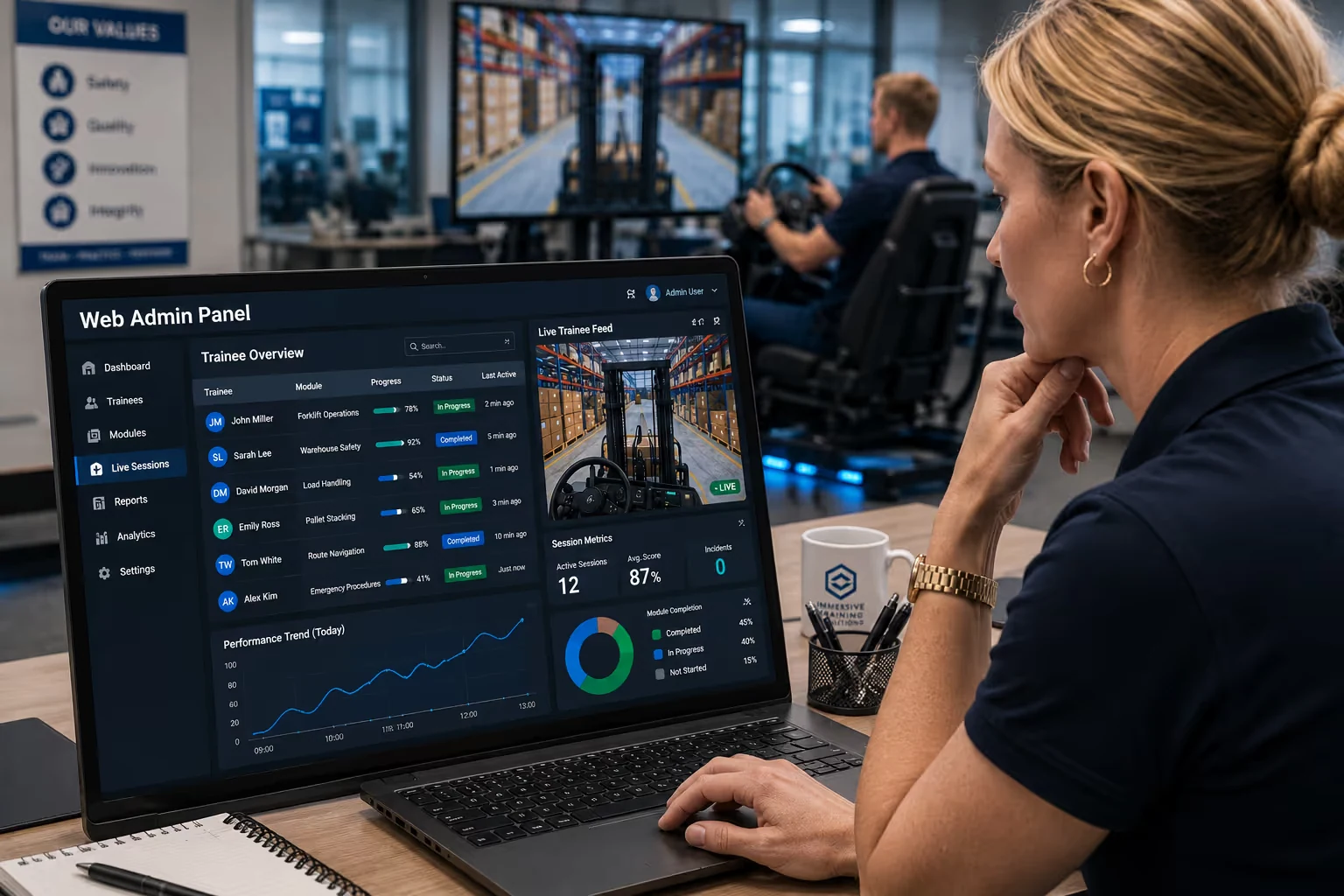
A secure, browser-based Web Admin Panel lets the instructor run the session. From it, they register trainees, assign modules such as basic navigation, load handling and hazard avoidance, and follow progress live. They see what the trainee sees in the headset, along with speed, steering angle and load height.
The instructor can also trigger events, such as a pedestrian stepping into the forklift's path, a spill on the floor or a mechanical failure alarm. This tests reaction time and emergency procedures, and lets the instructor adjust difficulty to each trainee.
360-degree replay
Every action in the simulator is recorded. After the session, instructor and trainee review it together from any angle: the driver's seat, a bird's-eye view or a pedestrian's position. If a trainee clips the racking while reversing, the instructor can pause, switch to the overhead view and show exactly how the turning radius was misjudged. Seeing the mistake is clearer than being told about it, and it keeps the debrief objective.
Results
The institution reported these outcomes:
- Equipment utilisation: active forklifts and pallet jacks no longer need to leave production for the foundational stages of the curriculum.
- Training speed: trainees reach competency milestones up to 30% faster, helped by the realism and replay debriefs.
- Safety: no property damage or near-misses during simulated training modules.
- Assessment: objective, data-driven scoring in the Web Admin Panel keeps standards consistent across groups.
Because trainees arrive at the real forklift already familiar with the controls and hazards, the final physical phase carries less risk of accidents, product damage and wear on brakes and gears. Less time on real machines also means lower fuel and maintenance costs. Faster progress lets the institution train more operators in the same time, which lowers the cost per trainee. The source notes that fewer training accidents also contribute to lower insurance premiums.
For compliance, the panel's records give clear evidence that each operator was trained and assessed on specific hazard scenarios, which helps during safety audits. The PC-tethered rig with physical controls costs more upfront than a standalone headset, but these savings provide the return.
What it means for manufacturers
Any plant or warehouse that trains its own forklift operators faces the same trade-off: take machines out of production and accept risk, or keep training mostly theoretical. A realistic simulator removes most of that trade-off for the early stages of training.
The key lesson is fidelity. For heavy machinery, realistic physics, physical controls and instructor tools matter more than portability. A simulator that feels like a game teaches the wrong lessons, while one that behaves like the machine builds skills that transfer.
Frequently asked questions
Why use PC-tethered VR instead of a standalone headset for forklift training?
A PC provides much more graphics power. That is needed to render a detailed, physics-accurate warehouse at a high, steady frame rate, which prevents motion sickness and makes the simulation realistic enough for OSHA-aligned training.
How important are the physical steering wheel and pedals?
Very. Driving a forklift depends on muscle memory, and standard VR controllers do not build it. The Logitech G920 wheel and pedals match the feel to the visuals, so the skills transfer to the real machine.
What does the Web Admin Panel let instructors do?
Register trainees, assign modules, watch progress live, see the trainee's view and trigger hazards during a session. It also stores the data used for compliance reporting.
Does the simulator replace training on a real forklift?
No. It covers the foundational and intermediate stages: controls, spatial awareness and hazard avoidance. Trainees must still complete a final phase of physical training and assessment on a real forklift for full certification.
Can the virtual warehouse match a specific facility?
Yes. The software can be customised to replicate a specific warehouse layout, including its racking, typical loads and pedestrian routes.
Does OSHA require VR training?
No. OSHA does not currently mandate VR, but it strongly encourages thorough hazard-recognition training. The simulator's analytics and replays provide documented evidence of each trainee's competence, which supports compliance.
More on vr training & events
 Insight · VR training
How a Big-4 consulting firm assessed AI maturity for 10,000+ employees with gamified podiums
How a Big-4 consulting firm assessed the AI maturity of over 10,000 employees with floor podium quizzes in its offices, sorting staff into four maturity bands.
Read the article Insight · VR training
The 3-minute rule: running high-throughput VR and hologram displays at corporate events
How a professional services firm ran VR and hologram fans at an internal summit, using 3-minute experiences to serve about 15 people per headset an hour.
Read the article Insight · VR training
How phygital welding and painting simulators train skilled workers in India
How phygital welding and painting simulators, pairing XR headsets with real-feel torches and spray guns, cut training material costs by up to 70% in India.
Read the article