

Industry insight: this article describes how the technology is used in the industry. It is not a Metaverse911 client project. See our case studies for our own work.
The situation: incident rates had stopped falling
Heavy industry, including manufacturing, mining, oil and gas, and construction, carries a wide range of serious hazards. One site may need its workers to be competent in lockout/tagout (LOTO), confined space entry, working at heights and arc flash safety. Training for all of this usually meant a patchwork of classroom lectures, generic safety videos and costly physical simulations that rarely conveyed the real danger.
A multinational heavy manufacturing conglomerate found that its incident rates had plateaued despite heavy investment in health, safety and environment (HSE) training. Workers knew the theory and could pass a multiple-choice test on LOTO, but they lacked a real sense of what a mistake would mean. Under production pressure, that theory did not always become safe behaviour.
Language was a second problem. The workforce spans facilities in North America, Europe and Asia, and an English safety video loses much of its meaning for non-native speakers. The group needed immersive training that covered its full risk profile, worked across languages and could be deployed straight away, without the cost and lead time of building custom VR modules.
What they did: an off-the-shelf library on standalone headsets
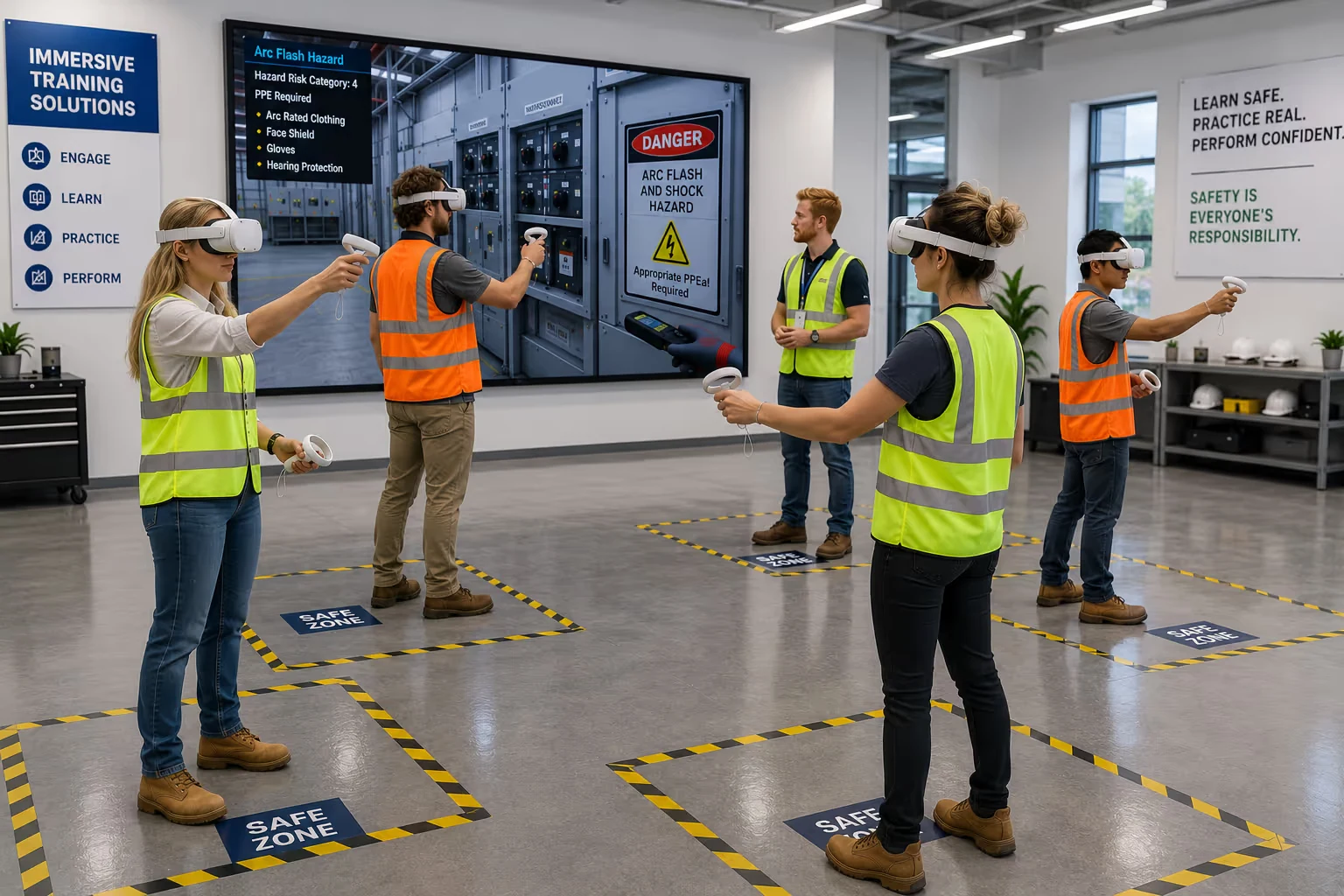
The conglomerate partnered with a global VR safety software developer and deployed a ready-made library of 17 heavy industry safety modules. It used standalone VR headsets, so there was no need for PC rigs. Training could happen on the factory floor, in break rooms or in remote mining camps, and workers did not have to travel to a central academy.
A complete training kit fits in a single hard case and can be shipped to any facility. A local safety officer can set it up in under five minutes. The headsets offer six degrees of freedom (6DoF), so trainees walk around equipment, crouch to inspect valves and physically pull levers or attach padlocks. That physical movement builds muscle memory.
How it works
Three modes, from learning to exam
The modules are interactive, physics-based simulations rather than 360-degree videos. Each one follows three stages, which stops trainees from simply gaming the system:
- Learning mode: step-by-step guidance with visual prompts, voiceover and highlighted controls, for example the exact steps to apply a LOTO device, verify zero energy and secure the area.
- Training mode: the prompts are removed and the trainee works from memory. Mistakes get immediate feedback explaining what went wrong.
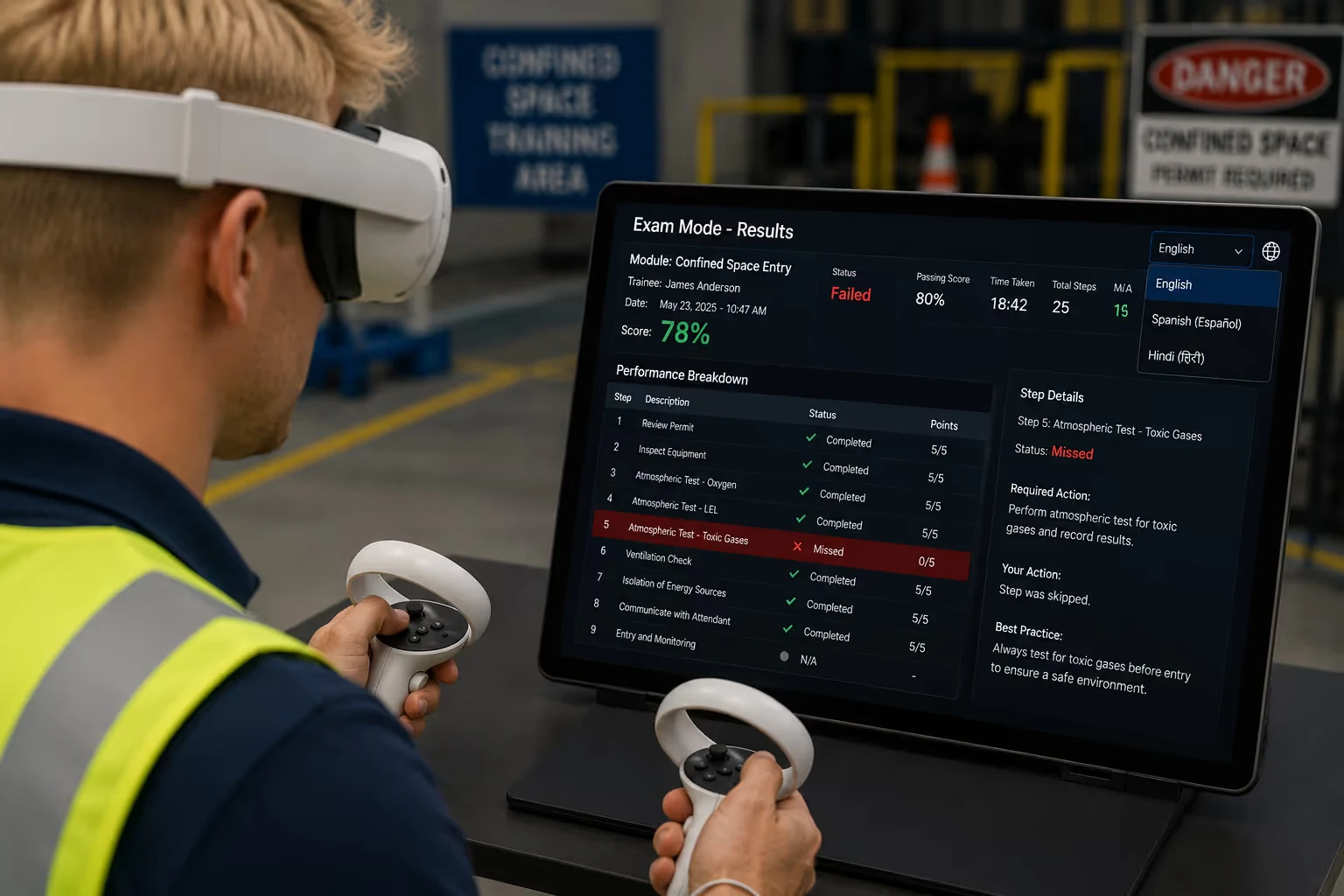
- Exam mode: an unassisted, timed assessment with random hazards such as a gas leak, a tool failure or a distracting virtual co-worker. Every action is recorded, and a pass/fail report goes automatically to the Learning Management System (LMS).
The hazards covered
Key modules deployed by the conglomerate included:
- Arc flash and electrical safety: PPE selection, safe distances and the use of insulated tools, with a virtual arc flash that trainees remember.
- Confined space entry: atmospheric testing, continuous monitoring and emergency extraction in tight, poorly lit tanks and silos.
- Lockout/tagout: identifying every electrical, pneumatic and hydraulic energy source on multi-stage machinery and isolating them in the right order.
- Underground mining hazards: roof fall prevention, gas detection and navigation to emergency refuges.
The whole library runs with voiceover and text in 18 languages, so every worker is trained in their own language.
Results
The conglomerate reported these results:
- All 17 modules deployed across global facilities in 60 days, against an estimated 2 years for custom in-house development.
- An estimated 80% saving in upfront software costs compared with custom development.
- A 60% reduction in the cost of delivering high-risk safety training, as physical simulation setups, consumables and instructor travel were no longer needed.
- A 4× improvement in protocol recall during high-stress simulations, compared with classroom learning.
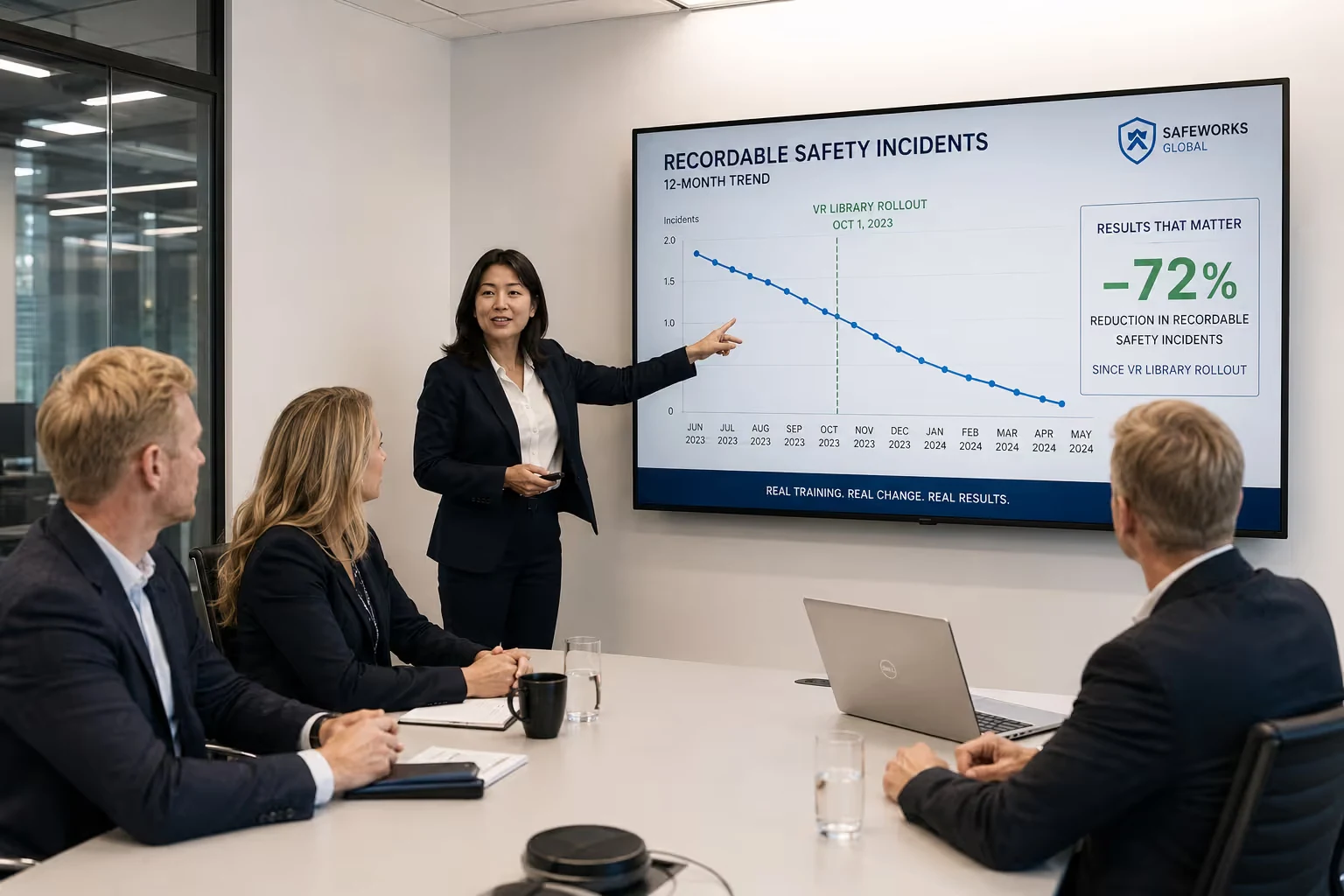
- A 35% reduction in recordable safety incidents within the first year.
Plant managers no longer had to shut down sections of the plant or take machines offline for safety demonstrations. Workers could be trained in small groups during shift changes. HSE teams gained a single, standard platform for their whole risk profile instead of buying from several vendors. HR and L&D teams gained objective, auditable data on competency from Exam mode. Fewer incidents also mean fewer compensation claims, lower insurance premiums and fewer production stoppages.
What it means for manufacturers
For common hazards such as arc flash, confined spaces and LOTO, a ready-made VR library can be in use within weeks, while custom modules take far longer. Custom development is still the right choice for proprietary machinery and plant-specific procedures.
The other lessons are practical. Standalone headsets make it easy to train on site and in small groups. A structured path from guided learning to a timed exam proves competence rather than familiarity. Training in each worker's own language matters in any plant with a mixed workforce.
Frequently asked questions
Why choose an off-the-shelf VR library instead of custom modules?
Custom development works well for proprietary machinery, but it is expensive and slow. For universal hazards like arc flash, confined space or LOTO, a ready-made library gives tested simulations at a fraction of the cost and time.
Are standalone headsets powerful enough for safety simulations?
Yes. Modern standalone headsets such as the Meta Quest 3 can render detailed industrial environments and physics interactions. They are portable and easy to use, with no need for expensive PCs.
How does the system make sure trainees really learn the procedure?
Through the three modes. Trainees must complete the procedure without prompts in Training mode before the Exam mode, which is timed and adds random hazards to test situational awareness.
Can the modules handle a multilingual workforce?
Yes. The library in this example supports 18 languages. Trainees choose their language for voiceovers, text prompts and menus.
What results did the heavy industry conglomerate report from its VR safety library?
The heavy manufacturing conglomerate reported deploying all 17 VR safety modules across its global facilities in 60 days, an estimated 80% saving in upfront software costs, a 60% reduction in the cost of delivering high-risk safety training, a 4 times improvement in protocol recall, and a 35% reduction in recordable safety incidents within the first year.
More on vr training & events
 Insight · VR training
How a Big-4 consulting firm assessed AI maturity for 10,000+ employees with gamified podiums
How a Big-4 consulting firm assessed the AI maturity of over 10,000 employees with floor podium quizzes in its offices, sorting staff into four maturity bands.
Read the article Insight · VR training
The 3-minute rule: running high-throughput VR and hologram displays at corporate events
How a professional services firm ran VR and hologram fans at an internal summit, using 3-minute experiences to serve about 15 people per headset an hour.
Read the article Insight · VR training
How phygital welding and painting simulators train skilled workers in India
How phygital welding and painting simulators, pairing XR headsets with real-feel torches and spray guns, cut training material costs by up to 70% in India.
Read the article