


Industry insight: this article describes how the technology is used in the industry. It is not a Metaverse911 client project. See our case studies for our own work.
The situation: paper binders and rising demands
This plant in Pune had run for decades on laminated work-instruction binders, paper quality checklists and knowledge passed from experienced operators to new ones. Its customers, global automakers, were asking for tighter quality, just-in-time delivery and many more product variants.
The paper system was struggling. Operators could spend minutes or even hours finding the right Standard Operating Procedure (SOP), and it was sometimes out of date. Experienced operators relied on memory, while new hires were overwhelmed, which led to high attrition and repeated retraining. Errors such as small misalignments, wrong torque values and missed inspection points put important contracts at risk.
The turning point came during a pre-production run for a new export order. Setup errors, caused by a misread, poorly photocopied manual page, led to a 12-hour line stoppage. Leadership decided the paper-based system had become a liability.

What they did: AR linked to the MES
The company launched a smart factory programme that combined AR with its existing Manufacturing Execution System (MES), delivered on standard industrial-grade iPads and Android tablets. It describes the approach as "e-Jidoka": a modern take on the Toyota Production System principle of autonomation, using technology to support the operator rather than replace them.
The rollout started with a pilot on one high-priority line. A cross-functional group of "digital champions", including operators, maintenance staff and quality inspectors, was trained first and gave feedback to refine the interface and workflows before the plant-wide rollout. Training took place on the shop floor, and most operators were comfortable with the system within a single shift.
How it works
- 3D CAD models and procedures are loaded into a central AR platform, which links each instruction to a specific machine part or assembly zone.
- When an operator points a tablet at equipment, computer vision recognises it and streams the relevant AR content.
- During a changeover, for example, the tablet highlights which valves to adjust, in what order, and the torque settings, all on the live camera view.
- The operator confirms each step with a tap. The MES logs the time, operator ID and any values entered, creating a complete audit trail.
The platform also connects to PLM and ERP. Maintenance technicians see the failing part highlighted, an animated 3D repair sequence, and whether a spare is in stock and where it is stored. High-risk tasks show mandatory safety warnings that the operator must confirm.
Security was built in: a segregated plant-wide Wi-Fi network, encryption in transit and at rest, a firewall from the open internet, and role-based access so each person sees only what their task needs.

Results
The manufacturer reported:
- A 35% reduction in machine downtime, with Mean Time To Repair (MTTR) cut by nearly 50%.
- First-pass yield up from 82% to 97%, with end-of-line rework and scrap almost eliminated.
- Onboarding time for new operators on complex lines reduced by over 60%, from weeks to days.
- Defect escape rate reduced by over 60% through in-process AR quality checks.
- Employee retention improved by 25%.
- Full return on investment in just under 11 months.
Better quality also brought higher customer audit scores and fewer post-sale quality claims. Faster changeovers shortened time-to-market for new components. Engineers now use data on frequent failures and wear patterns to improve designs and processes. In 2024 the facility won the Gold Award for "Excellence in Digitalization" from the Automotive Component Manufacturers Association of India (ACMA).

What it means for manufacturers
For Indian component makers facing tougher quality demands, skills shortages and global competition, this example shows a practical starting point for shop floor digitisation. It does not need headsets. It uses tablets that operators already know how to use.
The key is the two-way link with the MES. Instructions reach the operator in context, and every confirmed step flows back as data for quality, traceability and improvement. Starting with one line and a group of trained champions made the plant-wide rollout smoother.
Frequently asked questions
Can tablet AR work outside automotive?
Yes. Guided work instructions, quality checks and maintenance support with tablet AR apply to any industry with complex manual processes, including aerospace, heavy machinery, pharmaceuticals and consumer goods.
How long does a pilot take?
A pilot on one production line or a critical machine can typically be deployed in 6–8 weeks.
What does it cost compared with headset-based AR?
Significantly less, because it uses existing industrial tablets such as iPads or rugged Android devices. The main investment is software and integration.
What results are typical, and how soon?
Typical improvements are a 15–30% reduction in MTTR, a 20–40% improvement in first-pass yield and a 50% reduction in training time for new operators. Results often show within the first 3–6 months of a pilot.
How does tablet AR linked to an MES work on an auto component shop floor?
On the Pune Tier-1 auto component shop floor, 3D CAD models and procedures are loaded into a central AR platform. When an operator points a tablet at equipment, computer vision recognises it and shows the relevant AR instructions, such as which valves to adjust and torque settings. Each confirmed step is logged in the MES, creating a complete audit trail.
More on augmented reality on the shop floor
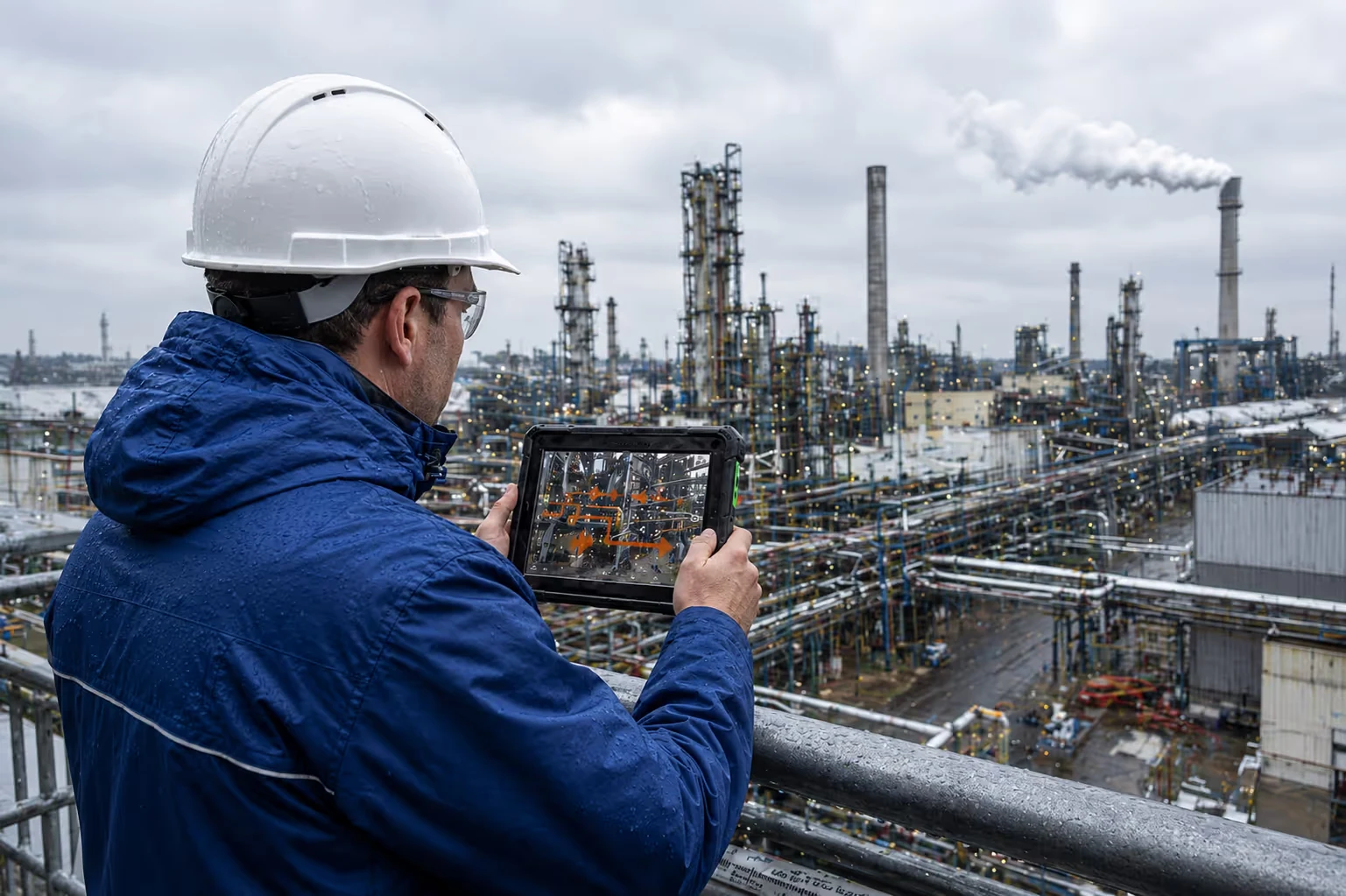 Insight · Tablet AR
How a chemical producer uses AR tablets in explosion-proof zones
How a chemical producer put intrinsically safe AR tablets in ATEX zones, linked them to DCS and SAP, and cut time-to-information from 15 minutes to under one.
Read the article Insight · Tablet AR
How a premium automaker uses tablet AR for quality checks on the assembly line
How a premium automaker in Leipzig used tablet AR, built with the Fraunhofer Society, to check parts on the line and halve supplier issue resolution time.
Read the article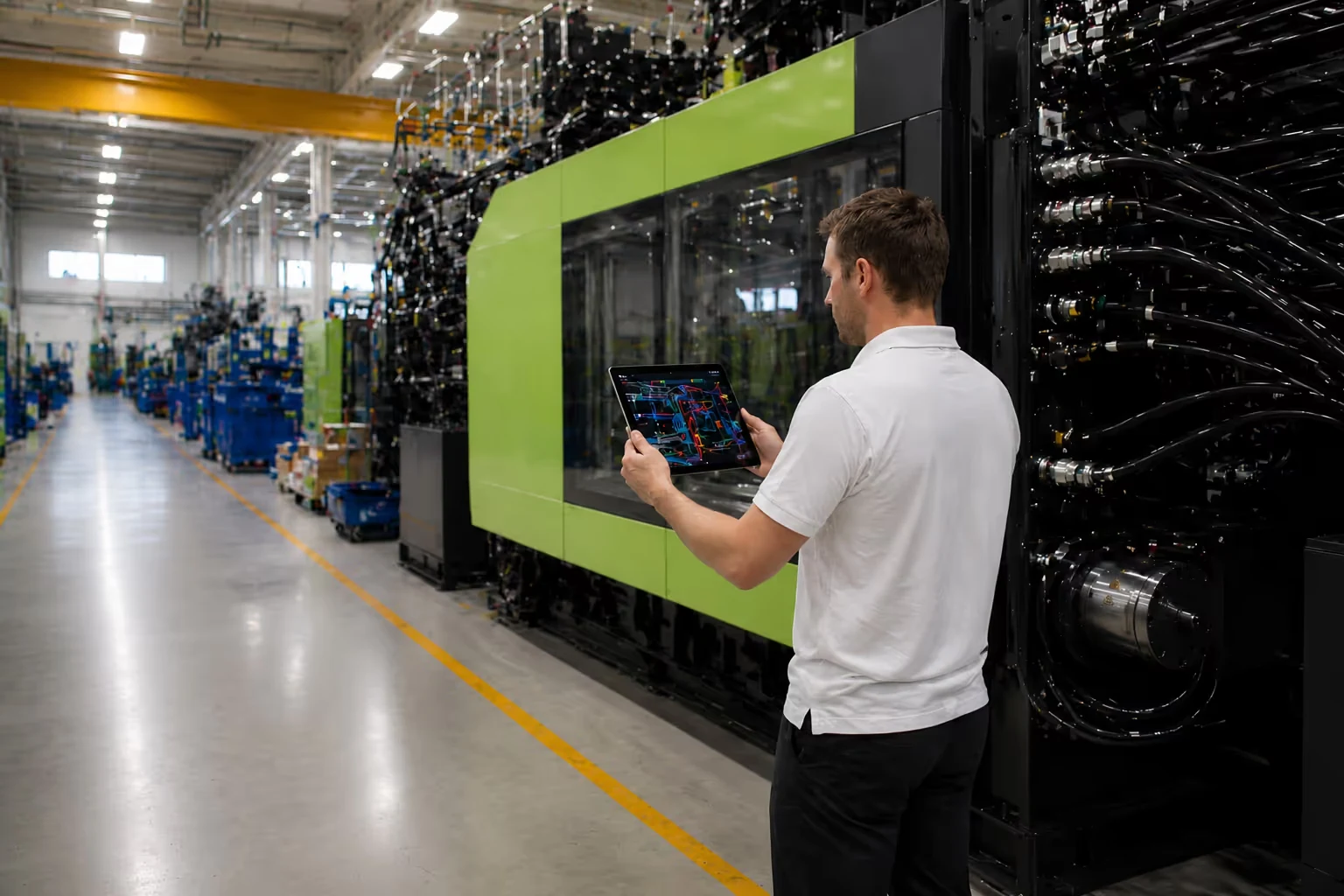 Insight · Tablet AR
How an injection moulding machinery maker uses tablet AR for final quality checks
How an injection moulding machinery maker used tablet AR and digital twins for final inspection, cutting inspection time by 75% and post-shipment errors by 90%.
Read the article